
Simple Homemade Dog Food Recipes for Your Dogs
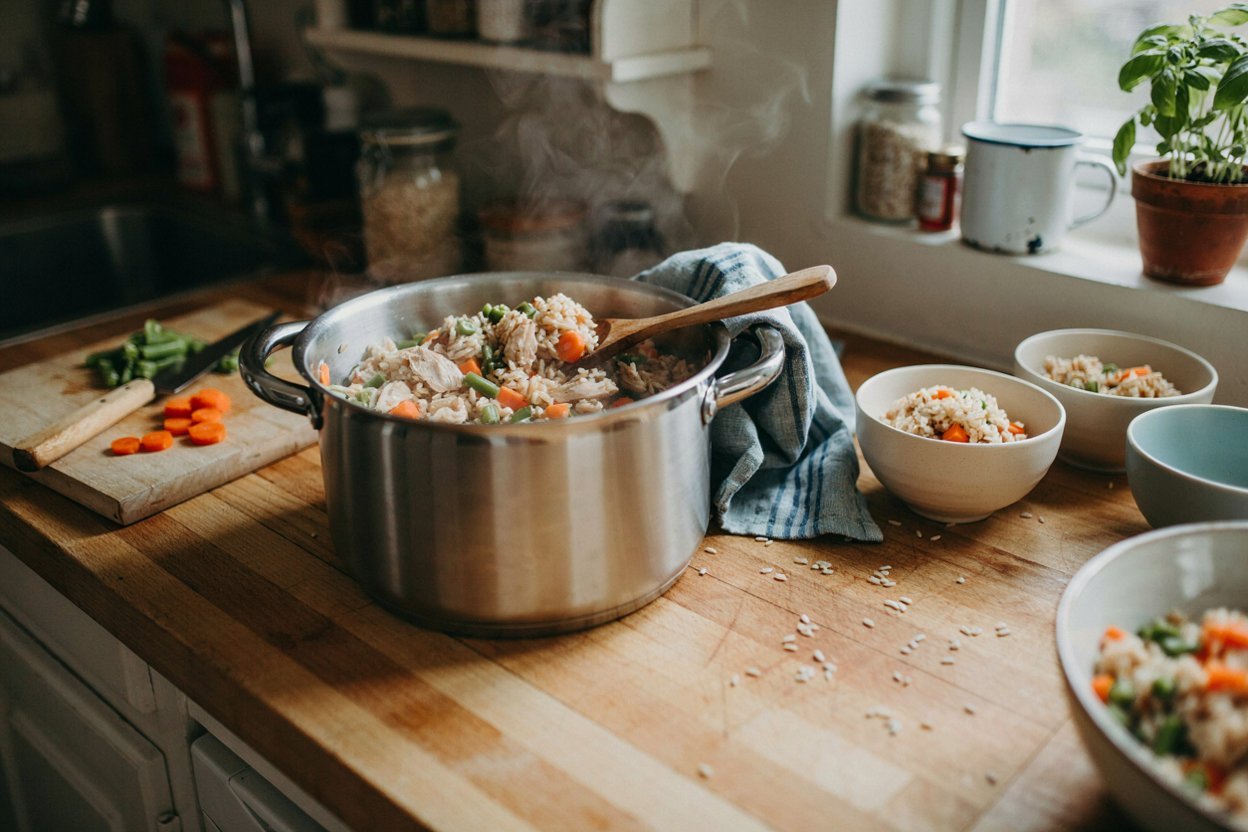
Cooking for one dog is simple enough once you’ve got a recipe down. Cooking for a household with more than one dog adds a layer most recipe guides don’t really address, since different dogs, even within the same house, often need different portion sizes, and sometimes genuinely different considerations depending on their age, size, or health.
This guide walks through one simple, flexible recipe built to scale easily across a multi-dog household, along with how to adjust portions and preparation so each dog actually gets what they need from the same pot.
If you want to build out your homemade cooking rotation beyond this one recipe, a few related guides are worth having open alongside this one.

Homemade dog food with vet approved ingredients covers what a fully balanced diet needs beyond just picking good ingredients, ground turkey dog food recipe for beginners and one pot homemade dog food recipes for beginners offer other simple starting points, simple homemade dog meals you can freeze is especially useful for a multi-dog household given how much larger a typical batch needs to be, homemade dog food recipes for small dogs is worth a look if your dogs vary significantly in size, healthy homemade dog meals you can make at home covers how to adjust a meal for specific health goals, budget friendly homemade dog food for busy pet parents covers shopping and batch cooking strategies that matter even more with multiple dogs to feed, and human foods dogs can safely eat is a good reference for what’s safe to share from your own kitchen more broadly.
Disclaimer: This post may contain affiliate links, which means I may earn a small commission at no extra cost to you. Always consult your veterinarian before changing your dog’s diet or introducing homemade meals.
Amazon Shopping List You Need
- Large Nonstick Cooking Pot with Lid
- Digital Kitchen Food Scale
- Glass Meal Prep Containers with Lids
- Stainless Steel Dog Food Bowls
- Airtight Dog Food Storage Container
- Silicone Freezer Portion Trays
- Dog Multivitamin Supplement Powder
Why Feeding Multiple Dogs From One Recipe Takes a Bit More Planning
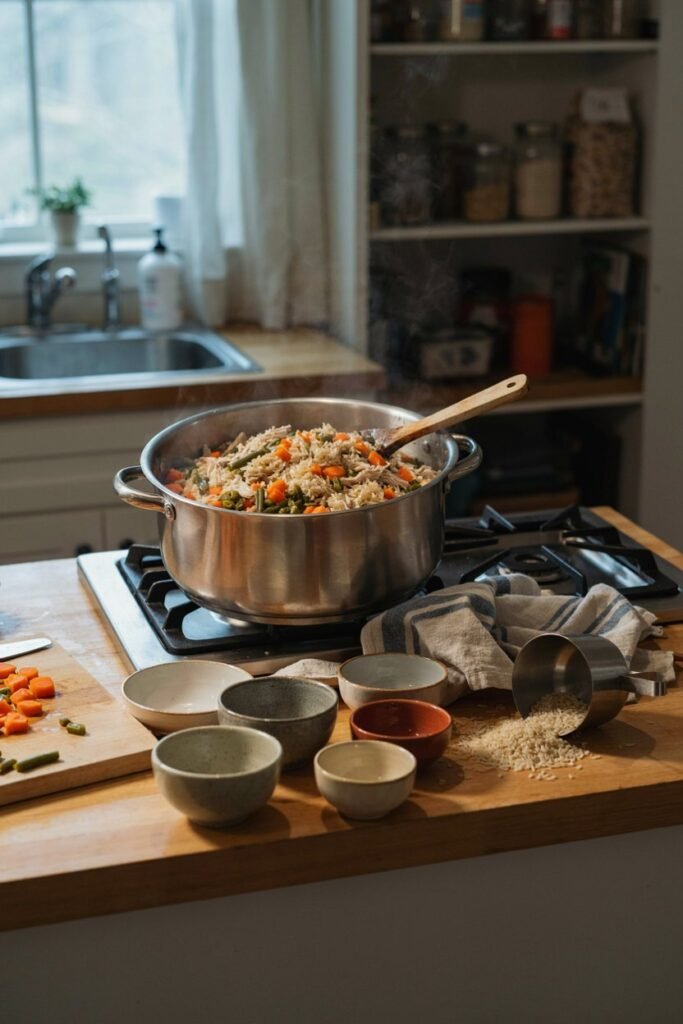
A single base recipe can genuinely work for an entire household of dogs, but it requires more deliberate portioning and occasional adjustment than cooking for just one.
A large breed and a small breed sharing the same recipe need very different serving sizes, obviously, but there are less obvious differences too.
An older dog in the house might need a softer texture or a lower calorie portion, while a younger, more active dog might need more food relative to their size.
Getting the base recipe right, then adjusting portions and small details per dog, is a much more efficient approach than cooking an entirely separate recipe for each one.
Before You Start
As with any homemade recipe, it’s worth being upfront that this recipe isn’t automatically a complete, nutritionally balanced diet suitable for daily, long term feeding just because it’s made from real, whole ingredients.
Dogs need appropriate amounts of protein, fat, carbohydrates, calcium, phosphorus, essential fatty acids, vitamins, minerals, and a range of trace nutrients, all in specific proportions that a simple recipe doesn’t fully provide on its own.
This meal works well as a regular addition, an occasional full meal, or a foundation you build on with proper supplementation.
If you’re planning to replace your dogs’ complete commercial diet entirely, working with a veterinarian is especially important in a multi-dog household, since each dog may have individually different needs that a single blanket approach can’t fully account for.
Understanding the Ingredients
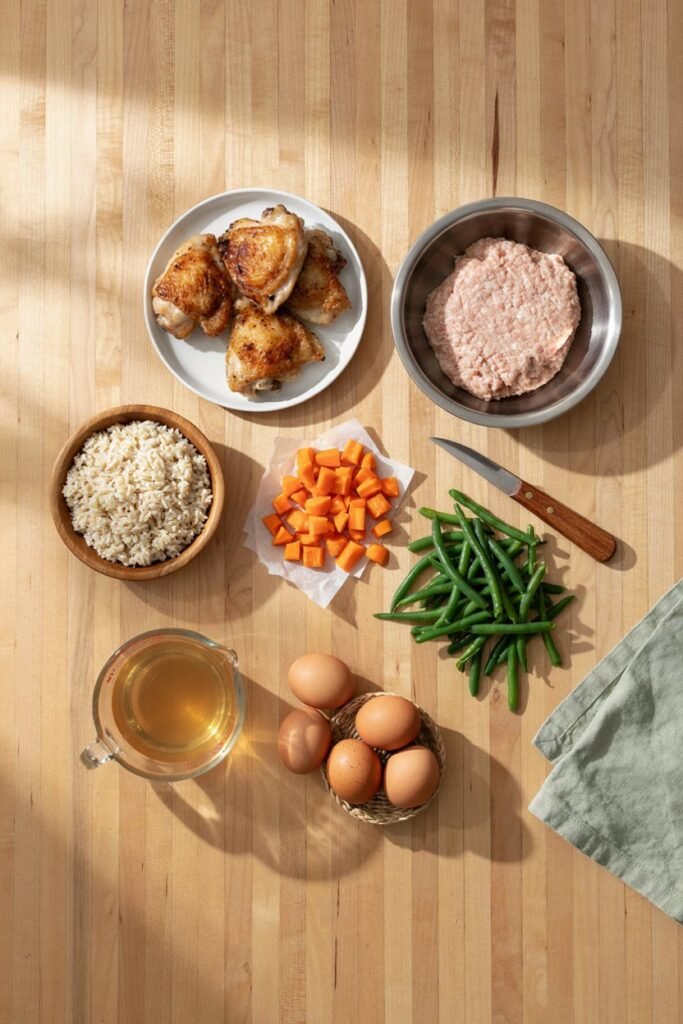
Chicken thighs or ground turkey. Both scale up easily for a larger batch and are consistently among the more affordable proteins, which matters more when you’re cooking enough to feed several dogs rather than one.
Brown rice. An inexpensive, filling carbohydrate that cooks well in a larger volume without much extra effort compared to a smaller batch.
Carrots and green beans. Both are cheap, easy to buy in bulk, and hold up well in a bigger pot without needing more attention than a smaller batch would.
Low sodium chicken broth. Used as the cooking liquid, and worth buying in a larger container specifically because a multi-dog household batch uses considerably more than a single dog’s recipe would.
Egg, added after cooking. Scales up easily, with the number of eggs simply increasing along with the rest of the batch size.
Fish oil, optional. Added at the very end, with the amount scaled based on the total number of servings rather than the total batch size, since dosing should still be calculated per dog rather than per pot.
Ingredients I Avoid
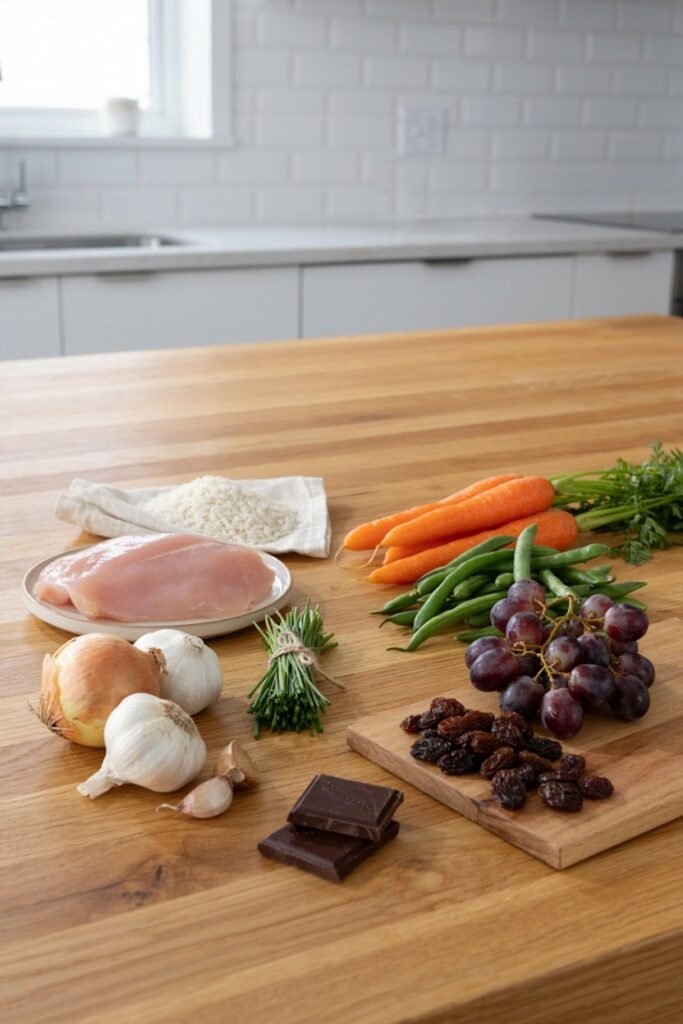
Onion, garlic, chives, excessive salt, seasoning blends, rich sauces, xylitol, grapes, raisins, chocolate, and cooked bones have no place in this recipe, and the stakes are arguably higher in a multi-dog household, since one unsafe ingredient in a shared batch affects every dog eating from it rather than just one.
Simple Homemade Dog Food for Multiple Dogs
Yield: About 16 to 20 servings, scaled for a multi-dog household (halve for a single dog) Prep Time: 15 minutes Cook Time: 35 to 40 minutes Total Time: About 55 minutes Storage: Refrigerate up to 4 days, freeze up to 3 months
Ingredients
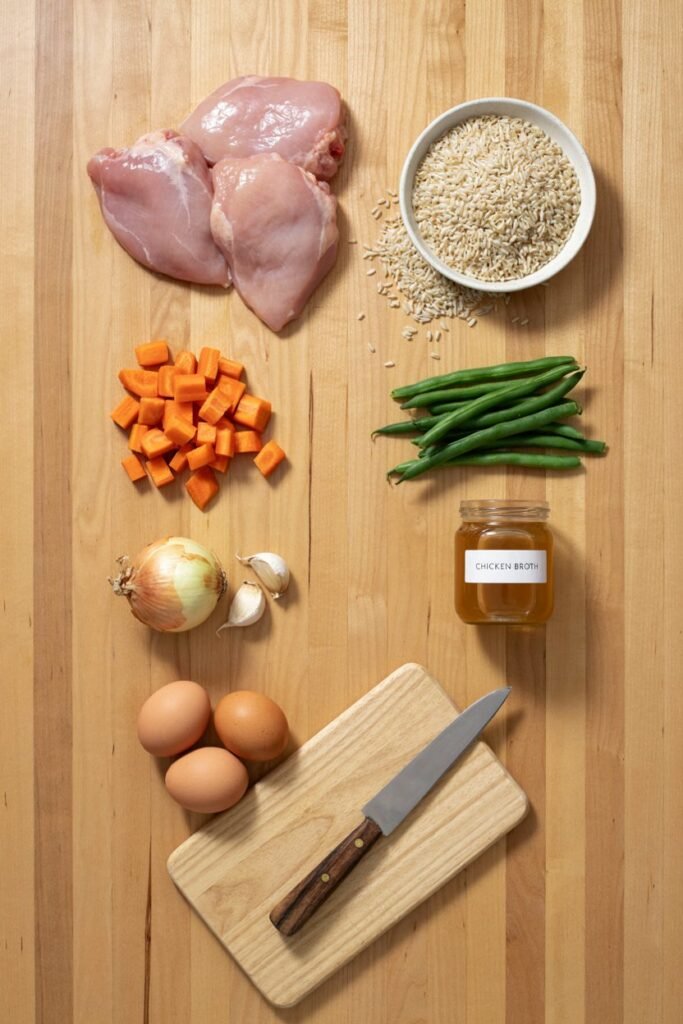
- 4 pounds chicken thighs or ground turkey: A larger batch of lean protein designed for households with multiple dogs. Remove excess skin and fat from chicken thighs before cooking.
- 3 cups uncooked brown rice: Provides carbohydrates and helps make the meal filling and satisfying.
- 2 cups chopped carrots: Add natural sweetness, fiber, and beta carotene.
- 2 cups chopped green beans: Provide fiber, vitamins, and minerals while adding variety to the meal.
- 6 cups low sodium chicken broth: Helps cook the rice and adds moisture and flavor. Make sure the broth is completely free from onion and garlic.
- 2 eggs: Add extra protein and nutrients. Scramble them separately without seasoning, then mix them into the cooked food once everything has cooled slightly.
How to Make It
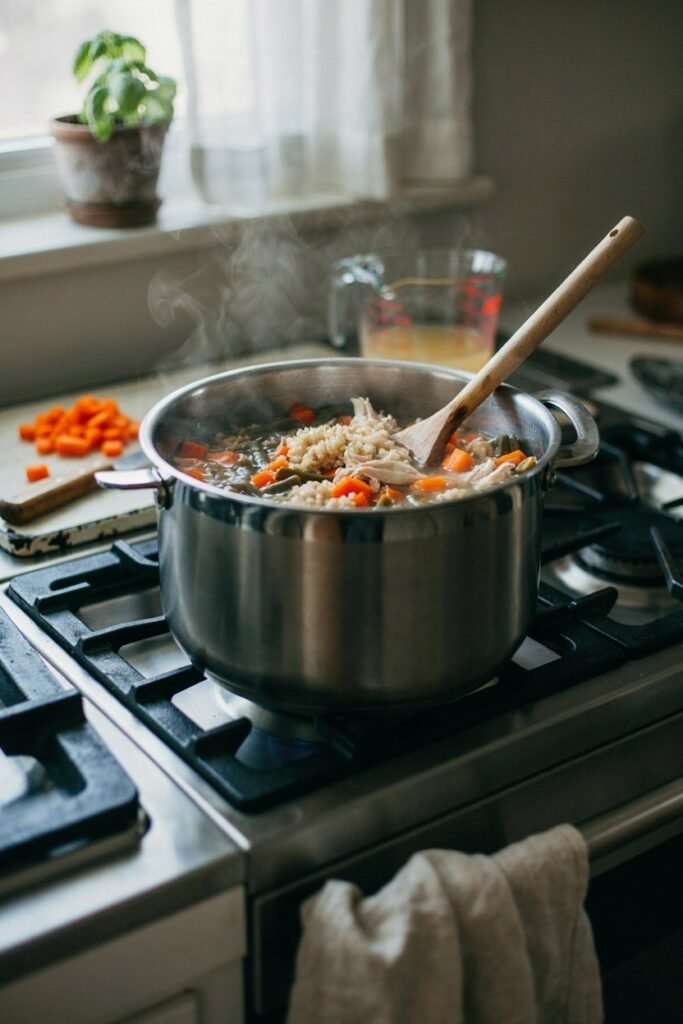
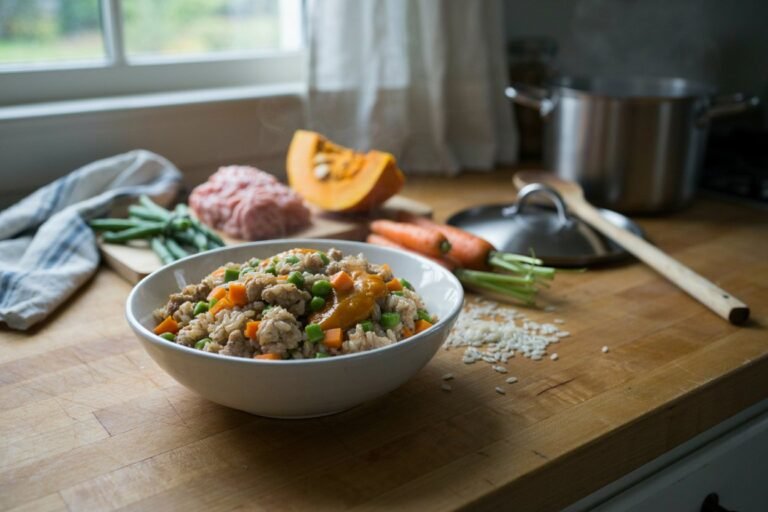
- Cook the chicken thighs or ground turkey thoroughly in a large pot, breaking it apart or shredding once cooked.
- Add the rice, carrots, and green beans directly to the same pot.
- Pour in the broth, stir to combine, bring to a simmer, then reduce heat, cover, and cook for about 25 to 30 minutes, stirring occasionally, until the rice is tender.
- Remove from heat and let the mixture cool to room temperature.
- Scramble the eggs separately, then stir them into the cooled mixture.
- Divide into individual, dog specific portions before refrigerating or freezing.
How to Portion This Recipe Across Multiple Dogs
This is really the part that matters most for a multi-dog household. Rather than dividing the finished batch into identical servings, portion it based on each dog’s individual weight, age, and activity level.
| Dog Size | Approximate Portion Per Meal |
|---|---|
| Small dog, 5 to 15 pounds | 1/4 to 1/2 cup |
| Medium dog, 16 to 40 pounds | 3/4 to 1.5 cups |
| Large dog, 41 to 70 pounds | 1.5 to 2.5 cups |
| Extra large dog, 70+ pounds | 2.5 cups or more, adjusted individually |
These are starting points, not fixed prescriptions, and they should be adjusted further based on each dog’s specific activity level and body condition.
A senior or less active dog may need a somewhat smaller portion than an active young dog of the same size and weight.
Labeling each dog’s portions separately when you divide up the batch, rather than trying to remember who gets how much at feeding time, makes this considerably easier to keep consistent day to day.
Storage
Refrigerator. Store in clean, airtight containers and use within about 4 days. Given the larger total volume in a multi-dog household batch, it’s worth splitting the refrigerated portion and the frozen portion clearly so you’re not tempted to keep too much in the fridge past the safe window.
Freezer. Portion into individual, per dog servings before freezing, ideally labeled with both the dog’s name and the date if you have dogs of noticeably different sizes. Most portions hold their quality for up to 3 months in the freezer.
Thawing. Thaw frozen portions in the refrigerator overnight rather than leaving them out at room temperature.
Reheating. Warm gently if desired, and always check that the food isn’t too hot before serving it.
Feeding Considerations for Different Dogs in the Same Household
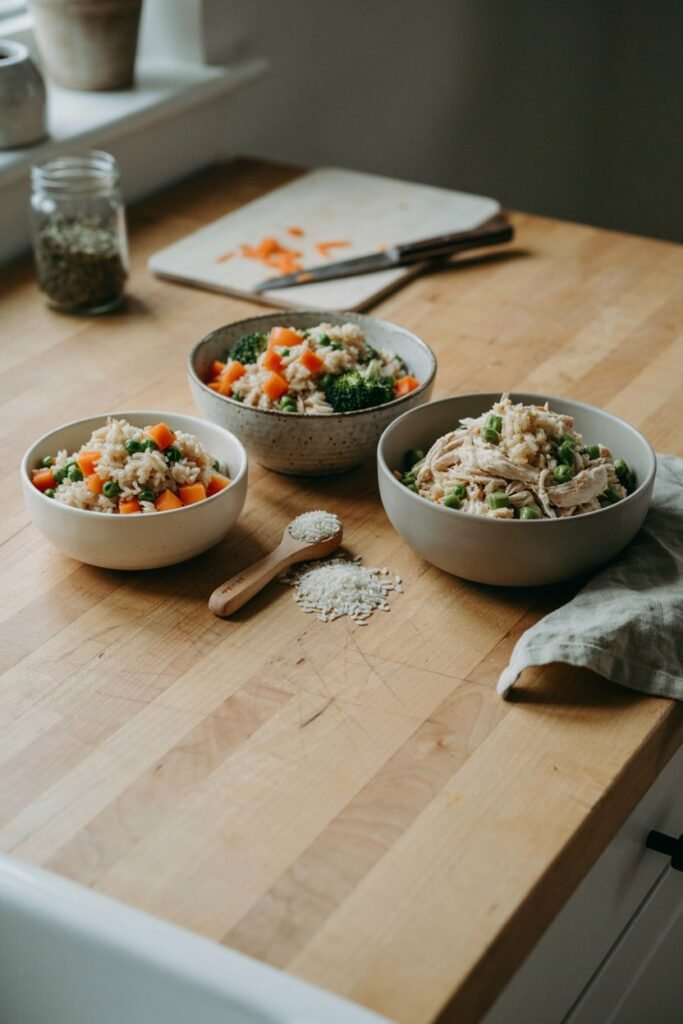
Size differences. A shared recipe works fine across different sized dogs as long as portions are adjusted individually rather than divided evenly, which is really the most important adjustment in a multi-dog home.
Age differences. A senior dog in the household may benefit from a softer texture, achieved by using a bit more broth relative to solids in their specific portion, or a smaller overall serving given a typically lower activity level compared to a younger housemate.
Activity level differences. Two dogs of similar size and age can still have meaningfully different calorie needs if one is considerably more active than the other, so it’s worth basing portions on each individual dog’s actual activity rather than assuming similar dogs need identical amounts.
Health conditions. If one dog in the household has a specific health condition, like kidney disease or a food allergy, that dog may need a separately formulated diet entirely rather than a portion of the shared household recipe, and it’s worth discussing with your veterinarian how to manage feeding multiple dogs with different needs safely, including keeping dogs from eating each other’s specifically formulated food.
How to Transition Multiple Dogs to This Recipe
Transition each dog individually rather than assuming they’ll all adjust at the same pace.
A gradual transition over about a week, starting with a small amount mixed into each dog’s regular food and increasing gradually, gives every dog’s digestive system time to adjust on its own timeline.
Watch each dog separately for loose stool, vomiting, excessive gas, or reduced appetite, since one dog tolerating the switch well doesn’t guarantee the same for another dog in the same house.
If any dog shows significant or persistent symptoms, slow their individual transition down or contact your veterinarian, even if the other dogs are doing fine.
Good Ingredients to Look For
Named animal proteins. Chicken and turkey both tell you exactly what’s going into the pot, which is always preferable to a vague or unspecified protein source, and both scale easily for a larger household batch.
Fiber rich vegetables. Carrots, green beans, and peas add volume, vitamins, and digestive support without excessive calories, and all hold up well to bulk cooking.
Digestible carbohydrates bought in larger quantities. Rice is one of the more reliably cheap carbohydrates per serving, especially useful when cooking a larger batch for several dogs at once.
Plain, onion and garlic free broth. A good broth adds real flavor and moisture without introducing anything unsafe, as long as the label is checked carefully every time, regardless of how many dogs are eating from the same batch.
Ingredients You Should Never Add
- Onion, garlic, and chives damage red blood cells and can cause anemia, even in small amounts.
- Excess salt and seasoning blends offer no benefit to a dog and can be genuinely harmful in larger quantities.
- Xylitol containing products cause a dangerous, rapid drop in blood sugar.
- Grapes and raisins can cause serious kidney problems, with no reliably safe amount.
- Chocolate is toxic even in modest amounts.
- Cooked bones can splinter and cause internal injury.
Common Mistakes to Avoid
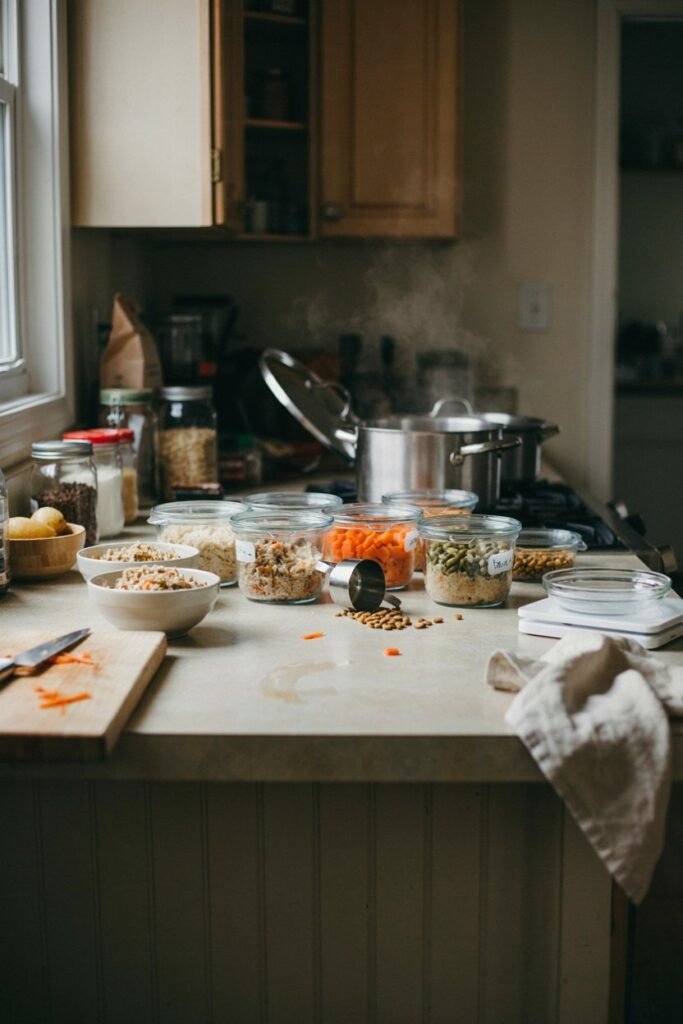
Dividing the batch into identical portions regardless of each dog’s size. This is the single most common mistake specific to multi-dog households, and it’s worth resisting the convenience of an even split in favor of individually appropriate portions.
Not labeling portions by dog. With multiple frozen servings that may look similar, labeling each one with the intended dog and portion size prevents mix ups at feeding time.
Assuming all dogs in the house will transition at the same pace. Each dog’s digestive system responds differently, so watching each one individually matters more than tracking the household as a whole.
Letting dogs share or swap portions freely. This becomes a real issue if any dog in the household has a specific dietary restriction or health condition, since an inappropriate portion for one dog could be genuinely harmful even if it’s perfectly fine for another.
Cooking a single batch too small for the household. Scaling the recipe up front for your actual number of dogs saves considerably more time than cooking multiple smaller batches throughout the week.
Frequently Asked Questions
Can I feed this recipe to all my dogs every day? As an occasional meal or topper for each dog, yes, without much concern. As a sole, long term diet, it should be reviewed and properly formulated with a veterinarian’s input first, ideally with each dog’s individual needs considered.
How do I know how much to scale the recipe for my household? Add up the approximate daily portions for each dog based on their size, then scale the recipe to produce enough total volume to cover a few days or weeks of combined feeding, adjusting the ingredient quantities proportionally.
What if my dogs are very different sizes? The same base recipe works fine across different sizes, as long as you portion it individually per dog rather than splitting the batch evenly. A small dog and large dog sharing a batch just means very different scoop sizes at serving time.
Can one dog eat the vegetables another dog seems to dislike? Yes, and it’s generally fine to leave a specific ingredient out of one dog’s portion if they consistently avoid it, as long as the overall meal remains reasonably balanced for that dog.
How long does this recipe last in the refrigerator? Generally about 4 days when stored in a clean, airtight container.
Can I freeze this recipe? Yes, portioning it into individual, per dog servings before freezing makes future meals much easier to manage, and it holds up well for up to 3 months frozen.
Do I need a calcium supplement for each dog? If you’re using this recipe as an occasional meal or topper, generally not. If you’re planning to feed it regularly as any dog’s primary diet, a vet recommended calcium supplement, dosed individually per dog, is usually necessary.
Can puppies in a multi-dog household eat this recipe? Puppies have different nutritional requirements because they’re actively growing, so this recipe shouldn’t become a puppy’s regular diet without a veterinarian reviewing it first, separate from how the adult dogs in the household are fed.
What if one of my dogs has a food allergy the others don’t? That dog likely needs a separately formulated diet rather than a portion of the shared household recipe, and it’s worth discussing with your veterinarian how to manage feeding multiple dogs safely when one has a specific restriction.
Is it more efficient to cook one large batch or separate batches for each dog? One larger batch, portioned individually afterward, is almost always more time efficient than cooking multiple separate batches, as long as all the dogs can safely eat the same base ingredients.
Simple Homemade Dog Food
Ingredients
Equipment
Method
- Cook the chicken thoroughly without adding salt, onion, garlic, oil, or seasonings.
- Allow the chicken to cool slightly, then remove any skin, bones, and excess fat.
- Shred or finely chop the cooked chicken into small pieces.
- Cook the brown rice until tender.
- Cook the carrots and green beans until soft.
- Add the chicken, rice, carrots, green beans, and pumpkin puree to a large mixing bowl.
- Add the water and gently stir until all the ingredients are evenly combined.
- Allow the food to cool completely before serving.
- Use plain, unseasoned ingredients and avoid onion, garlic, excessive salt, seasoning blends, and cooked bones.
- This recipe should not automatically be considered a complete and balanced long term diet. If homemade food is going to be a regular part of your dogs’ diet, have the recipe properly formulated for their individual nutritional needs.
Final Thoughts
Feeding a household of dogs from one homemade recipe is genuinely manageable once you shift the focus from cooking one meal to portioning one batch correctly.
The recipe itself doesn’t need to change much between one dog and several, but the attention you put into individual portion sizes, labeling, and watching each dog’s response separately makes the real difference.
Start with this recipe scaled to your household’s total needs, and adjust the portions as you get a better sense of what each of your dogs actually needs from it.

5 Comments